
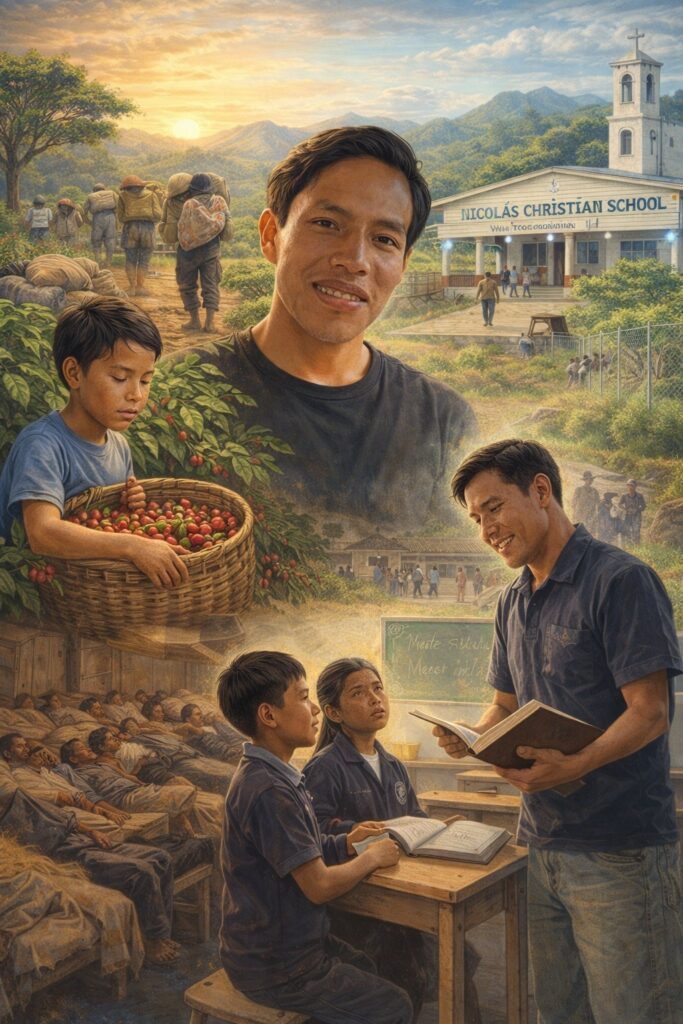
When Eliseo was just five years old, he began going with his family to the finca—a large commercial farm where poor families worked during the coffee harvest in Guatemala.
He was only a little boy, but he still remembers the hardship.
At that age, he was too small to pick much coffee. Some days, he could only fill part of a box. The pay was very low. If workers filled one box, they might earn 20 quetzales ($2.60). If they only filled half a box, they earned 10 ($1.30). For a child, and for a family living in poverty, every quetzal mattered.
When one finca did not have enough harvest, the family could not simply rest or go home and live in security. Instead, they carried their clothing on their shoulders and walked for kilometers to another finca, hoping there would be more coffee there and a better chance to earn money. They would stay for two or three months if the harvest was good, and when the work ended, they returned home for a short time until they had to leave again.
This pattern continued year after year. From 2004 until 2015, finca life shaped Eliseo’s childhood.
Life on the finca was extremely difficult. The work began early—very early. Sometimes the family got up at 2:30 or 3:00 in the morning. They had to walk long distances to the coffee fields, sometimes one or two kilometers on foot, before the day’s labor even began. When they picked a lot of coffee, they had to carry it back. Eliseo was still a child, but even he carried coffee in a basket.
The danger was real, too. In the coffee fields, there were snakes hidden among the leaves. There were mice. Once, Eliseo remembers that a snake fell directly into his basket while he was picking coffee. For a child, that was terrifying. But for families living that life, fear and hardship were simply part of the daily routine.
Life was hard.
The sleeping conditions were also hard. Families stayed in crowded workers’ quarters called galeras or dependientes. Sometimes, 100 to 200 people slept together in one large area. There were so many sacks, jackets, and belongings scattered on the floor that it was hard even to know which place belonged to whom. Sleep was difficult because of the noise, the crowding, and the crying babies. Even after a full day of labor, true rest was rare.
Water was sometimes unavailable. Clothes became soaked from carrying wet coffee, and when workers returned at the end of the day—often around 5:00 or 6:00 in the evening—they still had to wash their clothes and baskets before sleeping a few hours and waking again before dawn.
Food was basic and repetitive. Usually, there was one hired cook who prepared tortillas and simple meals for the workers. The food was often just beans and tortillas—two or three tortillas per person. Sometimes, if the finca served chicken or meat once a week, it felt like a celebration. Eliseo remembers how much people missed home. Even when food was provided, it was not the same as home, and there was little joy in it.
Sanitation was often terrible. In some places, there were no real toilets. People had to relieve themselves in the brush or under the coffee plants. In some cases, workers had to pick coffee near human waste around the sleeping quarters. It was degrading, unhealthy, and painful.
This was the world Eliseo knew as a boy.
And finca life was not his only burden.
From the age of six to thirteen, Eliseo also shined shoes from house to house. In one afternoon, he might earn 20 quetzales ($2.60). He used that money to help buy things for the family, like sugar or small household necessities. Even as a child, he was working to help his family survive.
He completed sixth grade in 2011, and like many children in poor rural communities, he wanted to continue studying. But there were no clear opportunities.
Poverty was a constant barrier.
Violence in the Cotzal area also made travel dangerous. He said there was so much crime that people feared going out because they could be killed. So instead of continuing in school, the most obvious path was to keep returning to the finca.
The family had no stable salary and no secure future. They would work for two or three months, come home, buy necessities, and within ten days, much of the money would be gone. Then it was back to the finca again. It was a cycle of survival with no clear way out.
Then, in 2015, everything changed.
Just as Eliseo’s family was preparing to return to the finca once again, Nicolás Christian School arrived in his village.
His mother went to a meeting and learned that a Christian school had come and that students were enrolling. She came home and told him about it. That moment changed the direction of his life.
Eliseo enrolled. And because of Nicolás Christian School, he did not return to the finca.
For him, this was a radical turning point.
Education did not make life easy overnight. The needs at home were still real. There was still pressure to work and help provide for the family. Eliseo says that, in some ways, his parents were right to worry because the need in the home was genuine. But by God’s grace, he fought for the opportunity to study.
He began secondary school older than many of the others. He entered primero básico at age 17. His class began with 16 students. Over time, the number kept shrinking. By the time they reached graduation in quinto bachillerato, only 8 students remained.
Eliseo stayed.
Along the way, the school gave him much more than academic instruction. It gave him guidance, discipline, and vision. He remembers teachers like Professor Samuel, who challenged students to remain focused and not get distracted. When Eliseo began paying too much attention to a girl at school, Professor Samuel lovingly corrected him, telling him to stay focused on his studies and graduate first. Eliseo listened.
His teachers also pushed him to grow in ways he did not naturally enjoy. Señor María often told him,
“You have to read. You can improve, but you have to read.”
At first, Eliseo did not like reading. He resisted it. But gradually, he began to read, and through reading, his thinking began to change. His mind opened. His understanding of the world grew. Education was not only giving him knowledge; it was transforming the way he saw life.
After graduation, Nicolás Christian School invited him back to serve as a tutor for younger students. For Eliseo, this was an extraordinary moment. The school that had once opened a door for him was now asking him to help open doors for others. He still felt shy speaking in public, but he accepted the opportunity with gratitude and pride. He carried his backpack and his notebook and began teaching in the afternoons.
Then came another major step.
He was selected for the 10 Talents scholarship program, which enabled him to continue his studies at the university level. This deepened his growth even further and helped move him toward the life he lives today.
Education changed not only Eliseo’s circumstances but also his inner life and his faith.
His parents had taught him to pray and seek God from childhood. At home, the family prayed almost every day. But Eliseo says the school also played a significant role in drawing him closer to God. Through devotionals and the school’s Christian environment, his relationship with God deepened.
Later, at the university, he began studying theology. At first, reading the Bible felt like an obligation, even a punishment, because it was part of his assignments. But little by little, that changed. He began to enjoy Scripture. He began to love the stories of the Bible. And through Scripture, he says, he came to see God in a different way.
One of the deepest lessons he learned was this: following God does not mean living free from hardship.
He had once believed, as many people around him believed, that if someone truly followed God, nothing bad would happen to them. But as he studied the Bible, he realized that faith does not remove suffering, sickness, or trials. Instead, God is with His people in the middle of suffering.
That truth changed his understanding of God, life, and faith
Today, Eliseo says Christian education changed his life.
It changed how he sees the world. It opened doors. It gave him dignity, opportunity, and purpose. He says plainly that if he had not studied, he would not know where he would be.
And when Eliseo thinks about the future of his village—Villa Hortensia Uno, with its 230 families—he believes education can help transform the community. But he also believes something deeper: true flourishing begins with God.
He says some people may have money, but if they are far from God, they still do not live in peace.
Material resources alone cannot create flourishing. A village can be transformed when people come to know God, grow in wisdom, build stronger relationships, and begin to live with faith, hope, and purpose.
In Eliseo’s view, education is a powerful instrument of transformation, but it is Christian education—education that forms both mind and soul—that opens the door to real change.
Once, Eliseo’s life was shaped by poverty, instability, danger, and endless cycles of labor on the finca.
Now, because Nicolás Christian School and the Nicolás Fund for Education opened a different door, he sees a different future—not only for himself, but for his village.
And with gratitude, he says:
“If I had not studied, who knows where I would be. Now I am here, thanks to God.”